
The Gospel, the Tiger, and a Pioneer Pastor: Remembering Rev. Thlo Zeng and the 1967 Matu Baptist Conference
The history of Christianity among the Matu-Chin people is preserved not only in official church records but also in the memories of families, villages, pastors, and elders who witnessed the early growth of the Christian faith in the Matupi region. Among these memories is the remarkable story of the 1967 Matu Baptist Association conference at Thitaeng (Cawngthia) village, an event remembered both for the large Christian gathering and for the extraordinary killing of a tiger during the conference. Closely connected with this history is the life and ministry of Rev. Thlo Zeng, one of the early Matu Christian converts and ministers.
The Arrival of Christianity in Thitaeng
Christianity first entered Matupi Township through the pioneering ministry of Rev. That Dun in 1944. The Christian message reached Thitaeng village, now known as Cawngthia, in 1948, and a Baptist church was established there in 1949.
Rev. Thlo Zeng was the first person from Thitaeng to embrace Christianity. He subsequently became the village's first pastor and belonged to the early generation of Christian ministers among the Matu people.
His commitment to the new faith began during the formative years of Christianity in the region. In 1946, he accompanied Rev. That Dun to Hakha, where they stayed at the home of Pastor Sang Ling. In the years that followed, Rev. Thlo Zeng traveled to villages such as Far Then, Aibur, and Naring (Senthang) to proclaim the Gospel.
Recognizing the importance of theological preparation, he traveled to Mizoram and, in 1952, studied theology at Jubilee Bible School in the Lunglei District. During his time in Lunglei, he encountered Paham Ai Bueng, an elder from his own village, who welcomed him and invited him to share a meal.
Rev. Thlo Zeng was originally from Sihmui, a Matu-Chin village predominantly inhabited by Matu people and, in more recent times, home to a significant Matu-Chin refugee population. In 1953, he served as a religious instructor, providing Sunday instruction to village elders, traditionally known as Pa Bu.
In 1955, he married Nuham Nu Lih at Dawrpui Presbyterian Church. After several years in Mizoram, he returned to Matupi in 1959. In March of that year, Rev. That Dun appointed him as a preacher, formally beginning a period of ministry in his native community that would leave an enduring legacy.
The Historic 1967 Matu Baptist Conference
One of the most memorable events in the Christian history of Thitaeng occurred in 1967, when the Matu-Chin people, together with the Kaipui ("Tiger") clan, hosted the Matu Baptist Association (MBA) conference, traditionally known as Civui.
The gathering became one of the largest Christian conferences held in the Matu region during that period. Although the official conference was scheduled from Friday through Sunday, preparations began several days earlier. Residents from the nearby villages of Lontun and Phanain reportedly arrived as early as Wednesday to assist the people of Thitaeng in preparing food and accommodation for the large number of visitors.
When the guests began arriving on Friday, the villagers welcomed them with remarkable hospitality. Families from Phanain and Lontun joined the host village in caring for the visitors. According to local recollections, individual households accommodated approximately seventy to eighty guests. In some cases, neighboring households worked together to prepare enough food to feed those entrusted to their care.
More than 500 people are believed to have attended the conference—a remarkable gathering considering the population, transportation difficulties, and limited resources of the period.
Yet the conference would become famous for something entirely unexpected.
The Tiger of the 1967 Conference
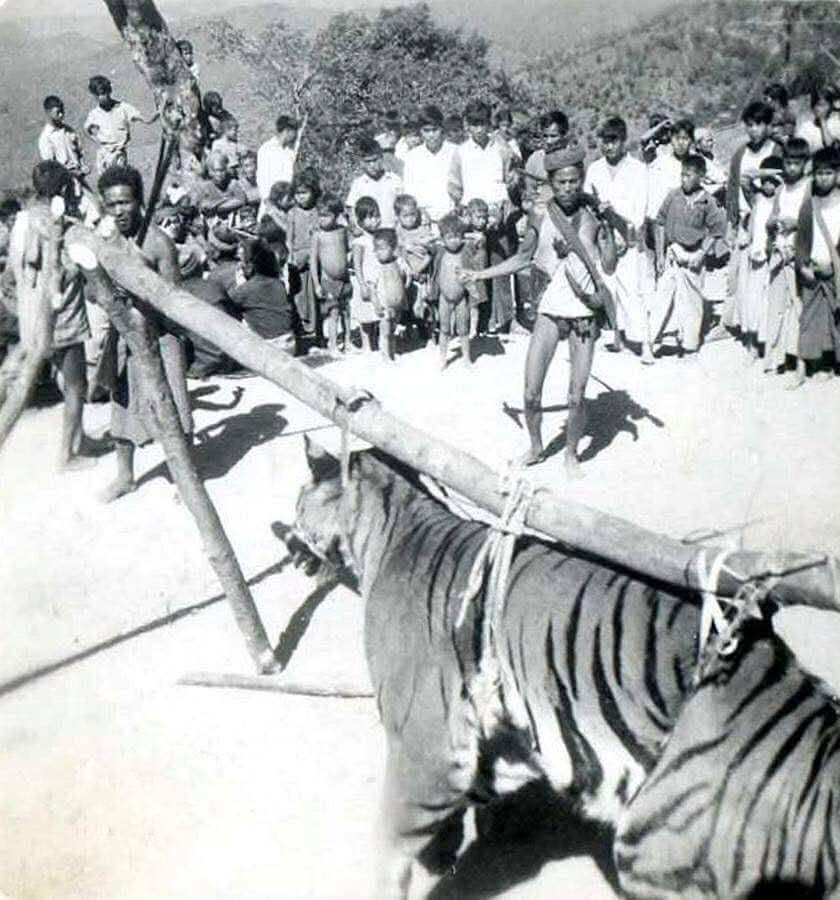
On the Friday when conference guests were arriving, some villagers went hunting. During the hunt, a man remembered as Pa Thang encountered and killed an exceptionally large tiger. According to local accounts, the animal measured approximately nine taung in length and nine let-sok—or fist-widths—in girth.
After removing the animal's entrails, Pa Thang carried the tiger back to the village. News quickly spread among the conference participants, and a large crowd gathered to see it. Those who witnessed the animal reportedly marveled at its extraordinary size.
Among those present was a sixteen-year-old girl who had traveled from Ting Long village to Thitaeng to attend the Baptist conference. She would later become the mother of one of Rev. Thlo Zeng's grandchildren. Her eyewitness recollection became part of the family's memory of the historic gathering.
The killing of such a large tiger carried enormous cultural significance in traditional Matu society. A successful tiger hunter could acquire considerable honor and renown within the community. Older traditions associated tiger hunting with beliefs and rituals surrounding death and the spirit world. According to oral accounts, when a renowned tiger hunter died, particular customary practices could be observed at his burial place, including the construction of a small structure associated with beliefs concerning the hunter's spirit.
The event at Thitaeng, however, came to be interpreted within a new Christian framework.
The Tiger and the Spread of the Gospel
Stories of the enormous tiger spread beyond the conference and reached surrounding villages, including communities where Christianity had not yet become established. In this way, an event that initially attracted attention because of its cultural significance became associated with the Christian gathering taking place at Thitaeng.
According to local Christian memory, people from non-Christian villages first heard more widely about the Christian conference because they had heard about the extraordinary tiger that had been killed during it. Their curiosity about the event brought attention to the Christian message proclaimed at the gathering.
Some local Christians consequently interpreted the incident providentially. The tiger itself was not the message; rather, the unusual event attracted attention to a gathering at which the Gospel was being proclaimed. What had long symbolized courage, prestige, and traditional belief within Matu society became unexpectedly connected with the spread of Christianity.
The story was therefore remembered by some Christians almost as a miracle of providence: a tiger was killed, people heard about the conference, and through hearing about the conference, they also heard about the Gospel.
For this reason, the 1967 Thitaeng conference remained deeply embedded in local memory. The story illustrates the complex ways in which Christianity took root within Matu society—not apart from existing culture and community life, but in the midst of them.
Rev. Thlo Zeng's Baptist Ministry
Rev. Thlo Zeng continued serving as a Matu Baptist minister in Thitaeng until 1968. From 1959 to 1968, he devoted nearly a decade to Baptist ministry among the Matu people.
His place within early Matu Christianity was significant. He was the first Christian convert from his village, its first pastor, one of the early Matu Christians to pursue theological education, and a member of the pioneering generation of indigenous ministers who helped establish Christianity among the Matu people.
In 1968, he personally accompanied Rev. Mang Tling from his village to Matupi, where Rev. Mang Tling would serve as secretary of the Matu Baptist Association.
That same year marked a major transition in Rev. Thlo Zeng's ministry. He left Baptist ministry and began serving within the Presbyterian Church.
The Presbyterian movement had arrived in Thitaeng in 1967 as part of missionary expansion into the southern Chin region associated with the Lushai (Mizo)-speaking Christian community based in Tahan, Kalaymyo. Rev. Thlo Zeng began his Presbyterian ministry in 1968. He subsequently served for three years in Thangpang village and another three years in Sami village, continuing a ministry that extended far beyond his initial Baptist service.
Over the course of his ministry, he baptized more than 200 people, including adults and young people. A monument was eventually erected in the village commemorating fifty years of his Christian ministry.
Rev. Thlo Zeng passed away in the Lord on January 30, 2015, at the age of ninety-four. His long life spanned an extraordinary period of transformation among the Matu people—from a time when Christianity was virtually unknown in many Matu villages to an era in which churches had become central institutions within Matu communities.
Remembering the Forgotten Pioneers
The preservation of Rev. Thlo Zeng's story also raises an important question about how Christian communities remember their pioneers.
At the 75th Anniversary, or Diamond Jubilee, celebration of the Matu Baptist movement, held at Nglaing Village and Matu That Dun Church, certificates of recognition were presented to various ministers, including early Matu pastors and evangelists, in appreciation of their contributions to the growth of Christianity among the Matu people.
Rev. Thlo Zeng, however, was not among those formally recognized.
His omission raises a legitimate historical question. Was his contribution overlooked because he later transitioned from Baptist ministry to the Presbyterian Church? If so, such an omission risks allowing later denominational affiliation to obscure an earlier period of important Christian service.
Rev. Thlo Zeng served within the Matu Baptist movement for nearly a decade during its formative years. His later Presbyterian ministry does not erase his earlier Baptist contribution. Historical memory should be broad enough to recognize individuals according to the work they actually performed, even when their denominational affiliation later changed.
Church history is most faithfully preserved when recognition is based not simply on institutional loyalty but on historical evidence, sacrificial service, and genuine contribution to the spread of the Gospel.
The stories of early pastors, evangelists, lay leaders, and ordinary believers deserve careful documentation before the generation that personally knew them passes away. Oral testimony should be compared with surviving church records, family documents, photographs, educational records, and denominational archives so that future generations may receive as complete a history as possible.
A Personal Legacy Across Generations
The story of Rev. Thlo Zeng is more than institutional history. It is also a story transmitted through generations.
His grandson had the privilege of personally knowing and speaking with both Paham Ai Bueng and Rev. Thlo Zeng while they were still alive. Their memories provided a living connection to the formative period of Christianity among the Matu people.
One particularly meaningful moment occurred in 2007. As his grandson prepared to leave for India to pursue theological studies, Rev. Thlo Zeng placed his hands upon his grandson's head and prayed for his journey and theological education.
That moment symbolically connected two generations of theological study and Christian ministry. More than half a century earlier, Rev. Thlo Zeng himself had traveled from the Chin region to Mizoram to study theology. Decades later, he prayed over his grandson as another generation departed for India to pursue theological education.
In that simple act of laying on hands and praying, a legacy was passed from one generation to another.
Conclusion
The story of the 1967 Matu Baptist conference at Thitaeng is a remarkable intersection of Christian mission, Matu culture, village hospitality, oral history, and family memory. Hundreds gathered to worship and hear the Gospel. Entire households opened their homes to visitors. Neighboring villages worked together to feed the crowds. And in the midst of the conference, the killing of an enormous tiger created a story that traveled far beyond the village itself.
Yet behind the dramatic story of the tiger stands an even more important story: the story of the men and women who carried the Gospel from village to village during the formative years of Matu Christianity.
Rev. Thlo Zeng was one of them.
As the first Christian convert and first pastor of Thitaeng, an early Matu theological student, a Baptist minister from 1959 to 1968, and later a longtime Presbyterian pastor, his life deserves a place in the historical record of Christianity among the Matu people.
Institutions may sometimes overlook names. Certificates may not always be given. Denominational histories may contain gaps. But faithful historical remembrance requires recovering those stories and preserving them for generations yet to come.
The legacy of Rev. Thlo Zeng is ultimately larger than any certificate of recognition. It lives in the churches he served, the people he baptized, the Gospel he preached, the communities he influenced, and the generations of Christian leaders who followed after him.
iChins' Translator’s and Editor’s Note: This article has been translated and adapted from information provided by Min Thang. The English version has been edited and arranged in a historical narrative style while seeking to preserve faithfully the substance of his original account.